How to Value Your TCG Cards (Magic, Pokémon, Yu-Gi-Oh & More)
A step-by-step guide to help you value your tcg cards (magic, pokémon, yu-gi-oh & more) quickly and accurately.
Every trading card game - Magic: The Gathering, Pokémon, Yu-Gi-Oh, and beyond - prices its cards using the same underlying logic, even though the games themselves are completely different. Once you understand the handful of factors that actually move a price, you can look at almost any card from any TCG and form a reasonable estimate of what it's worth before you even check a marketplace. This guide breaks down that universal process: the factors that drive price, how to grade condition honestly, which tools to use to check current prices, and the most common mistakes that lead collectors to overvalue or undervalue their cards. If you collect Magic specifically, we'll also show where Lotus Scan fits into this process to make it faster.
Step-by-Step Guide
Learn the 5 factors that drive card price
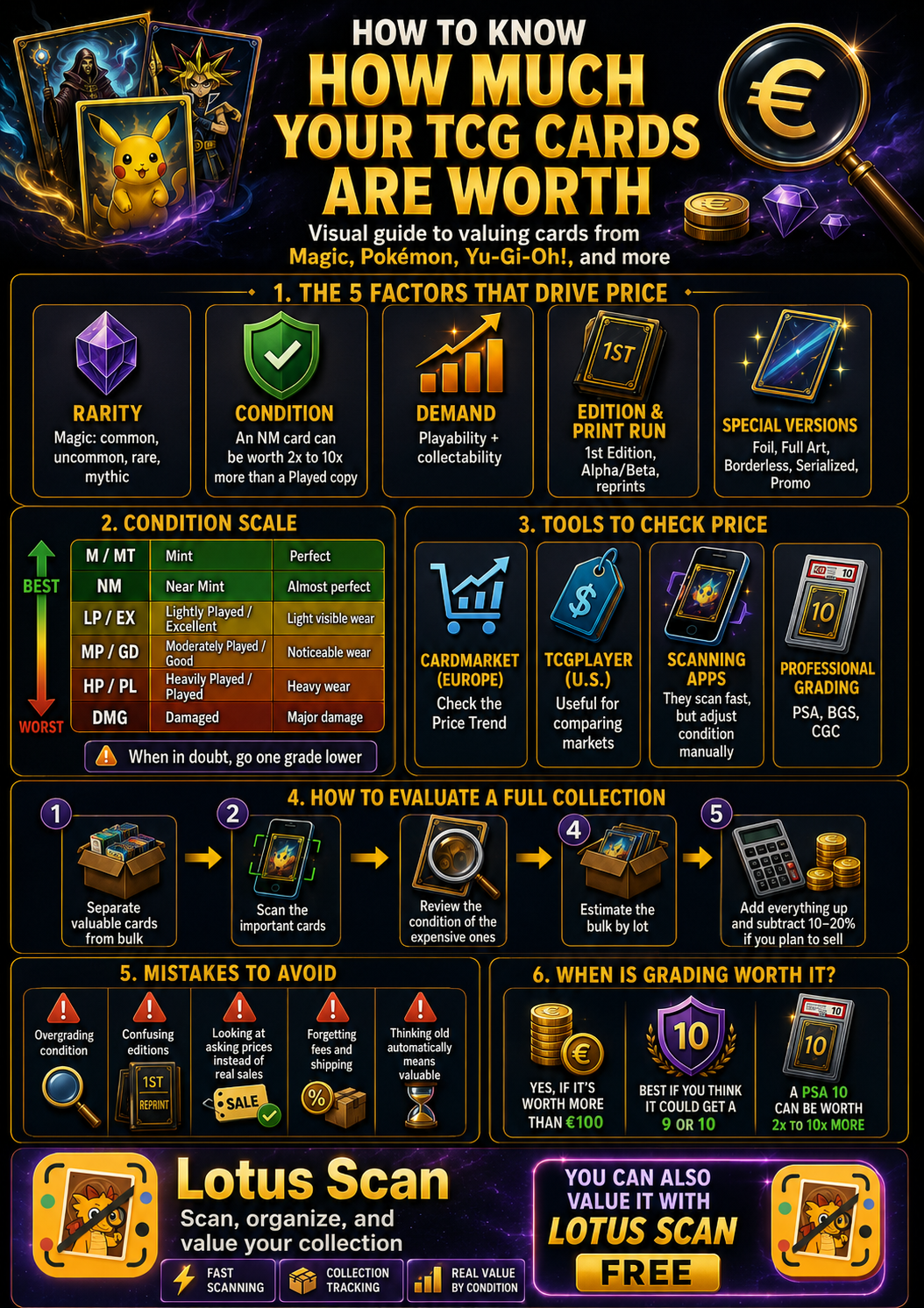
Almost every price difference between two cards comes down to five things. Rarity is the most obvious - commons and uncommons are usually cheap, while rares, mythics, secret rares, and ultra rares carry the value. Condition can swing the price by 2x to 10x between a pristine copy and a worn one. Demand matters as much as rarity - a card that sees competitive play or appears in a popular deck is worth more than an equally rare card nobody wants. Edition and print run decide how scarce a specific printing is - a first edition or Alpha/Beta-era card is worth far more than a modern reprint of the same name. Special versions - foil, full art, borderless, serialized, or promo printings - almost always carry a premium over the base version.
Tip: When two cards share a name but look different, you are usually looking at different printings with different prices. Always price the exact version in your hand, not the card name in general.
Understand the condition scale before you price anything
Every TCG marketplace uses some version of the same condition scale: Mint or Near Mint at the top, then Lightly Played or Excellent, Moderately Played or Good, Heavily Played or Played, and Damaged at the bottom. The exact labels vary by platform, but the idea is the same - whitening on the corners, scratches, scuffs, bent corners, and creasing all push a card down the scale, and each step down can mean a meaningfully lower price.
Tip: When in doubt, grade one step lower than you think. Sellers who consistently undergrade build trust; sellers who overgrade get returns and bad reviews.
Pick the right tool to check the price
Where you check the price depends on your market. Cardmarket is the standard reference for European prices across Magic, Pokémon, and Yu-Gi-Oh. TCGplayer is the equivalent for US prices and is useful for comparing against Cardmarket if you're buying or selling across regions. A scanning app is the fastest way to check a large pile of cards because it identifies the exact card and pulls a live price in seconds, though you still need to adjust the result for the card's actual condition. For cards that might be worth grading, professional graders like PSA, BGS, and CGC publish population reports and recent sale prices for graded copies.
Tip: If you collect Magic, Lotus Scan is built specifically for this - point your iPhone camera at a card, get the exact printing and a live price instantly, and set the condition yourself so the value reflects the real card in your hand, not just the card name.
Evaluate a full collection, not just one card
Pricing one card is easy. Pricing a binder, a box, or a whole collection takes a process. First, separate anything you know or suspect is valuable from the rest - in most collections, 80-90% of the total value sits in a small fraction of the cards. Scan or look up those important cards individually, since that's where mistakes cost the most money. Review the condition of the expensive ones carefully, since condition matters most when the base price is high. For everything left over, estimate the bulk lot at a flat rate per card rather than pricing each one individually. Finally, add it all together and subtract a realistic 10-20% if you plan to sell, since most buyers won't pay full market price.
Avoid the most common valuation mistakes
The biggest mistake is overgrading condition - assuming a card is Near Mint when it has visible wear, which inflates your estimate and disappoints buyers later. Second is confusing editions - looking up the wrong printing of a card with the same name and applying its price to a different, less valuable version. Third is pricing from asking prices instead of sold listings - what sellers are asking is not what buyers are actually paying. Fourth is forgetting fees, shipping, and marketplace cuts when comparing what a card is 'worth' against what you'd actually receive. Fifth is assuming old automatically means valuable - plenty of old commons and uncommons are still bulk, while some recent cards are worth far more than their age would suggest.
Decide when professional grading is worth it
Grading makes sense when a card is worth enough that a higher grade meaningfully increases its price, and when you genuinely think it could grade a 9 or 10. As a rough rule of thumb, grading starts to make financial sense once a raw card is worth more than roughly $100-150, since grading fees, shipping, and turnaround time eat into the return on cheaper cards. A PSA 10 or equivalent top grade can sell for 2x to 10x more than the same card ungraded, but a card that comes back as a 7 or 8 may not cover what you spent to grade it. Send your best, cleanest copies and leave played cards raw.
Short answer
A trading card's value comes down to rarity, condition, demand, edition/print run, and special versions like foil or full art. Check current prices on Cardmarket (Europe) or TCGplayer (US), or scan the card with an app for a fast, condition-adjusted estimate. For Magic specifically, Lotus Scan does this in one step on iPhone, for free.
The Universal TCG Condition Scale
Labels differ slightly by game and marketplace, but every TCG condition scale follows this same order, from best to worst.
| Grade | Common labels | What it means for price |
|---|---|---|
| Best | Mint (M) / Mint (MT) | Perfect or as close to perfect as exists; commands full or above-market price |
| Near top | Near Mint (NM) | Minor, often unnoticeable wear; the standard price you see quoted is usually this grade |
| Good | Lightly Played (LP) / Excellent (EX) | Light edge or corner wear; typically 10-20% below Near Mint |
| Moderate | Moderately Played (MP) / Good (GD) | Visible wear, possibly light scratches; often 30-50% below Near Mint |
| Heavy | Heavily Played (HP) / Played (PL) | Significant wear, creasing, or whitening; usually 50-70% below Near Mint |
| Worst | Damaged (DMG) | Major damage such as tears, water damage, or heavy creasing; often only bulk value regardless of rarity |
Where to Check TCG Card Prices
Different tools suit different goals - speed, regional accuracy, or confirming a grade before you sell.
| Tool | Best for | Caveat |
|---|---|---|
| Cardmarket | European price reference across Magic, Pokémon, and Yu-Gi-Oh | Prices can diverge from US marketplaces; check both if selling internationally |
| TCGplayer | US price reference and comparing against Cardmarket | Market price reflects asking prices on listings, not always the final sold price |
| Scanning apps (e.g. Lotus Scan for Magic) | Fast price checks across a large pile of cards | Still adjust the result for the card's actual condition - apps price the printing, not the condition |
| Professional grading (PSA, BGS, CGC) | Confirming value on cards that might grade a 9 or 10 | Only worth the fee and wait time on cards worth roughly $100+ raw |
Track Your Collection Value Over Time
See real-time market prices and historical charts for every card in your collection — all from a single scan session.
Pro Tips
- The same five factors - rarity, condition, demand, edition/print run, and special versions - apply whether you collect Magic, Pokémon, Yu-Gi-Oh, or any other TCG.
- Reprints reset price expectations. A card that was expensive before a popular reprint set can drop significantly once supply increases, even if demand stays the same.
- Cross-check at least two sources before trusting a single price. Cardmarket and TCGplayer can diverge meaningfully depending on regional demand.
- Foil and special-version cards need to be priced as their own variant, not as a markup guess on the regular version - the actual premium varies a lot card by card.
- For Magic specifically, scanning with an app like Lotus Scan removes the manual lookup step entirely and lets you set condition as you go, so your collection value stays accurate.
- Revalue anything you plan to sell or insure every few months. TCG prices move with the competitive meta, new sets, and reprints more than most collectors expect.