Black Lotus Price: How Much Is It Actually Worth?
From a $22.50 Beta copy in 1994 to a $3,000,000 private sale in 2024 — here's what Black Lotus costs today by edition and grade, and the full sale history behind the number.
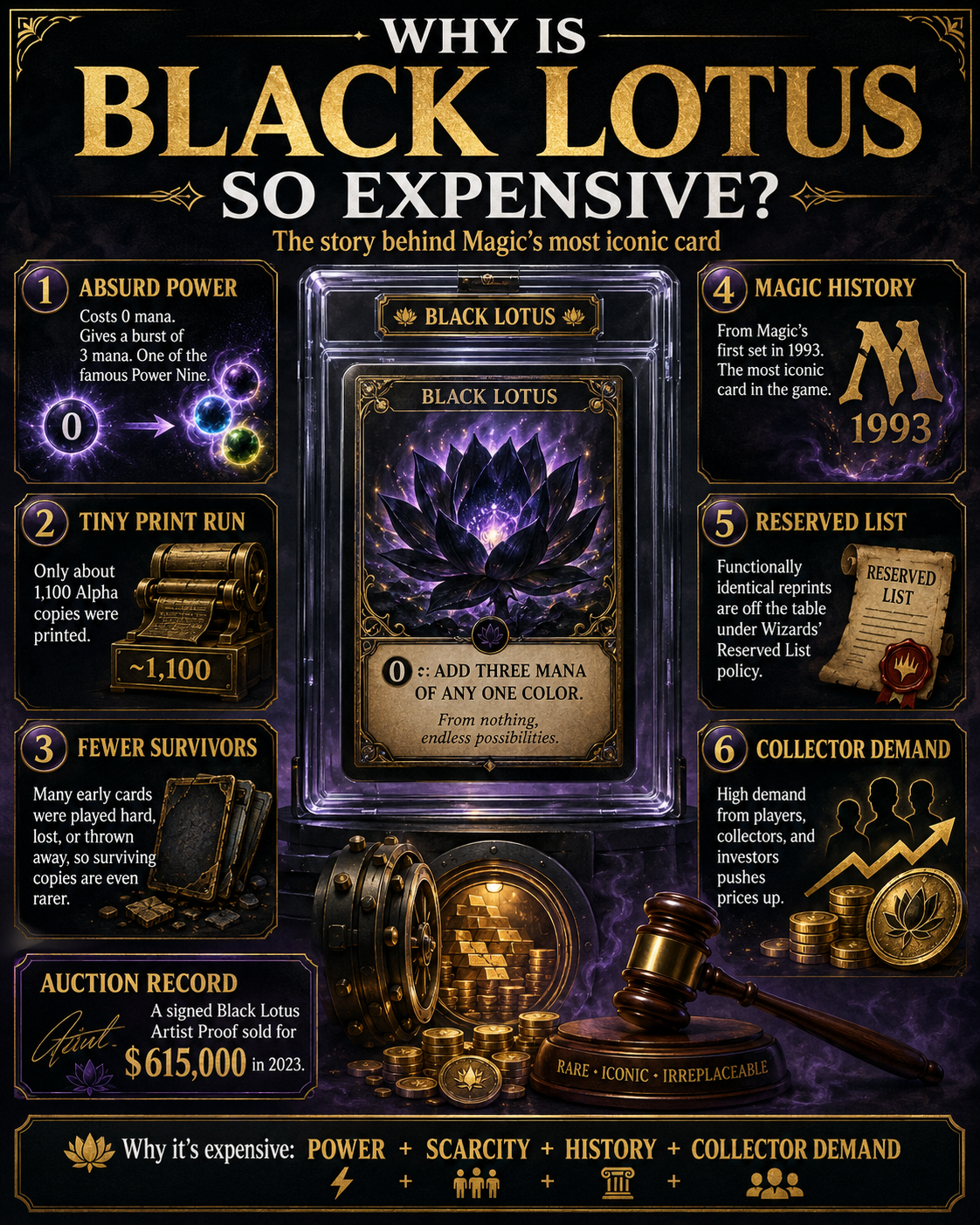
Black Lotus is a small piece of cardboard from 1993, and it is also the most expensive Magic: The Gathering card that exists, with a graded copy having sold privately for $3,000,000 in April 2024. That number gets thrown around a lot without context, and it can make the card sound like a fantasy that has nothing to do with what a real collector might actually pay. In practice, Black Lotus trades across a huge range depending on which of its four printings you have and what condition it is in — from around $13,000 for a played Unlimited copy up to seven figures for a perfect Alpha.
Below is the current price by edition and grade, the full sale history behind those numbers, and the reasons a single Magic card ended up worth more than most houses.
Quick Answer: Black Lotus Price by Edition
Black Lotus was printed in four tournament-relevant editions between 1993 and 1994, and the edition is the single biggest factor in what a copy is worth today. These are current asking-price ranges pulled from active listings and recent sales as of mid-2026.
| Edition | Typical price range | Notes |
|---|---|---|
| Alpha (1993, black border) | $27,000 – $130,000 raw or lower grade | The rarest print, roughly 1,100 made. Perfect-grade copies have sold for far more (see below). |
| Beta (1993, black border) | $13,500 – $500,000 | About 3,300 printed. Wide range because condition and grade matter enormously. |
| Unlimited (1993, white border) | $13,000 – $50,000 | Most common tournament-legal print, over 18,000 made. The realistic entry point into owning a real one. |
| Collectors'/International Edition | $3,300 – $6,000 | Square-cornered promo printing, not legal in any tournament format. |
| 30th Anniversary (2022 reprint) | $1,000 at original retail; graded copies have resold near $20,000 | Modern-framed proxy card with a unique back. Not tournament legal and explicitly excluded from the Reserved List promise. |
What Black Lotus Actually Does
Black Lotus is an artifact that costs nothing to cast. Once it is in play, a player can sacrifice it to add three mana of any single color to their mana pool, instantly. There is no risk and no downside — it is pure, free acceleration, which is why it is widely considered one of the most powerful cards ever printed for the game. Since a deck can normally run up to four copies of any non-land card, a player could in theory run four Black Lotuses, which is part of why the card was restricted so quickly.
Christopher Rush illustrated the card’s artwork. It was printed for Magic’s first three sets — Limited Edition Alpha and Beta, and Unlimited — all released in 1993. Alpha and Beta have black borders; Unlimited has a white border. It was left out of Revised Edition, the set that followed, along with the rest of the Power Nine, and none of the three original printings have ever been reproduced since.
How Many Were Printed
- Alpha: approximately 1,100 copies
- Beta: approximately 3,300 copies
- Unlimited: over 18,000 copies
Wizards of the Coast has stated the card will not be reprinted in a tournament-legal form. Along with the rest of the Power Nine and many other early cards, Black Lotus is on the Reserved List — a public commitment Wizards made in 1996 never to reprint those cards, specifically to protect their scarcity and collector value.
Black Lotus Price History
The price did not spike all at once. It climbed slowly for two decades, then accelerated hard once grading companies and auction houses started putting six and seven figures on individual copies.
| Year | Price | What sold |
|---|---|---|
| 1994 | $22.50 | Beta copy, earliest recorded resale price (Scrye Magazine, issue 1) |
| 2004 | ~$1,000 | Beta copy |
| 2013 | $27,302 | High-grade copy sold on eBay |
| 2014 | $3,376 | Beta copy |
| 2019 | $21,000 | Beta copy |
| June 2021 | $48,000 | Beta copy, then a record for that edition |
| January 2021 | $511,100 | Gem Mint Alpha, signed by artist Christopher Rush, sold via PWCC |
| 2022 | $800,000 | Signed Alpha artist's proof bought by musician Post Malone |
| March 2023 | $540,000 | Second signed Gem Mint Alpha from the same collection, sold via PWCC |
| April 2024 | $3,000,000 | Alpha graded CGC Pristine 10, the only one at that grade, sold privately |
Why the Price Took Off So Late
For its first decade, Black Lotus was worth real money but nothing like today’s prices. A Beta copy went for about $1,000 in 2004. The jump from there to today didn’t happen evenly: card-opening and collecting videos on YouTube through the 2010s turned pulling rare cards into a spectacle, the game’s original players from the 1990s reached an age where six-figure purchases became realistic, and third-party grading companies gave buyers a trusted way to pay a premium for a specific, verified condition instead of trusting a seller’s word. Once grading entered the picture, the gap between a played copy and a perfect one stopped being a small multiplier and became a difference of hundreds of thousands of dollars.
What Black Lotus Is Actually Listed For Right Now
Price guides show ranges, but here is what real listings looked like when we checked in mid-2026, to give a sense of where the market actually clears rather than just the extremes.
| Listing | Price |
|---|---|
| Alpha, ungraded (PriceCharting guide price) | $27,935 |
| Alpha, raw/authenticated (eBay) | $65,000 |
| Alpha, BGS 9.5 Gem Mint (Fanatics Collect) | $750,000 |
| Beta, played condition (eBay) | $13,500 |
| Beta, graded (Card Kingdom) | $69,000 |
| Unlimited, lightly played (TCGplayer) | $19,500 |
| Collectors'/International Edition, not tournament legal (Card Kingdom) | $3,900 |
Is Black Lotus Legal to Play?
Black Lotus is banned from every constructed Magic format except Vintage, and even in Vintage only one copy is allowed per deck instead of the usual four. It was restricted almost immediately after release and has stayed that way for over three decades. In practice, almost nobody who owns a real copy plays it — between the card’s value and its fragility, most owners keep it in a graded case rather than a sleeve.
Frequently Asked Questions
How much is Black Lotus worth?
What is an 8.5-graded Black Lotus worth?
How many Black Lotus cards are left?
Why is Black Lotus so expensive?
Did Post Malone buy a Black Lotus?
Who paid $3 million for a Magic card?
How much did a Black Lotus cost in 1993 and 1994?
Is Black Lotus a legal card?
Why was Black Lotus banned?
What's the cheapest way to own a real Black Lotus?
What Lotus Scan Looks Like Inside
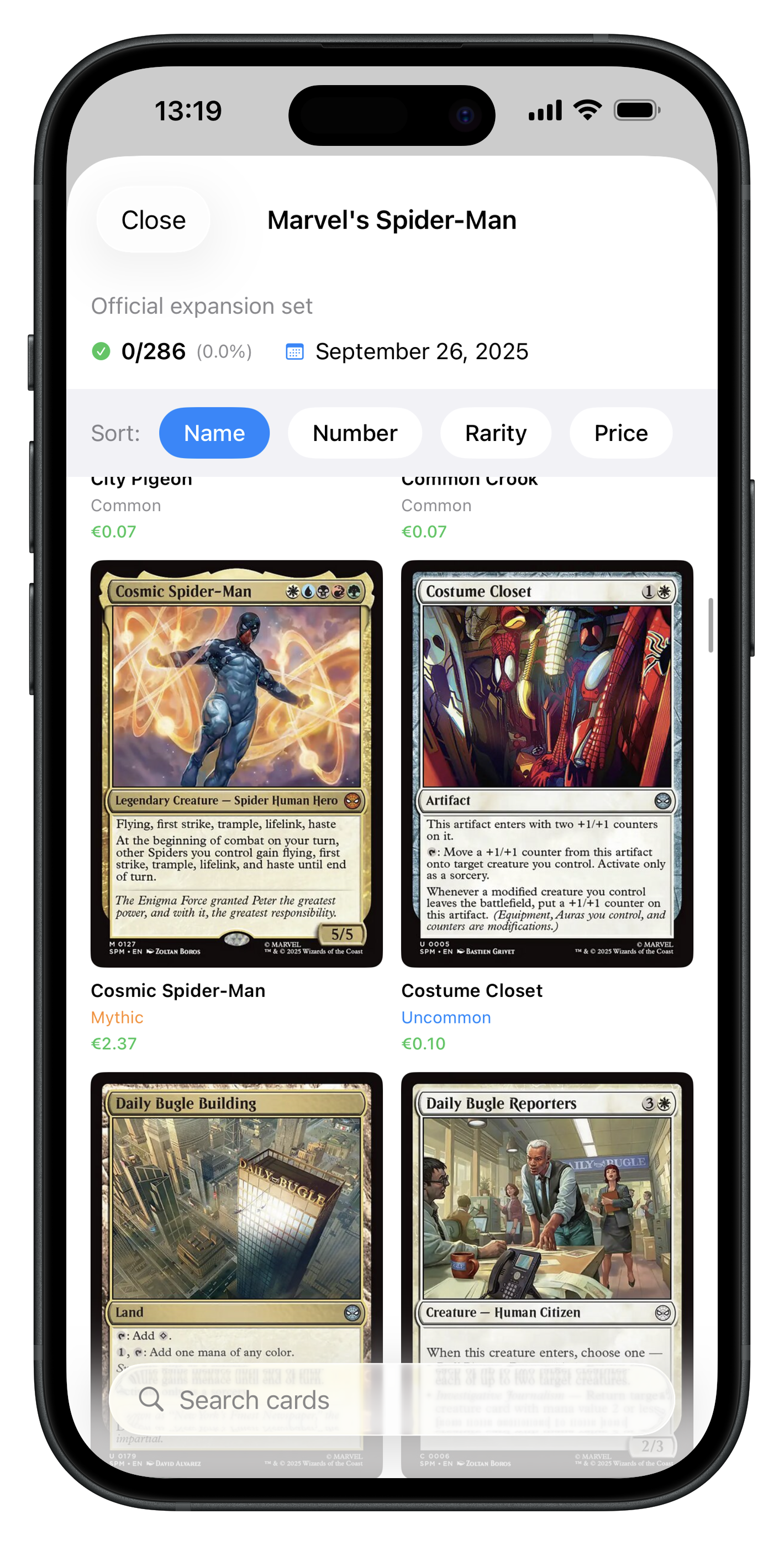
Point your phone at a card and Lotus Scan identifies it, shows the set and rarity, and pulls a live price — no white background or perfect lighting required. Here is what browsing a set looks like once your cards are scanned in.

Own Vintage Magic Cards? Know What They're Worth
Almost nobody pulls a real Black Lotus out of a bulk box, but plenty of people find Reserved List staples, old dual lands, and early-set cards they had no idea were valuable. Lotus Scan identifies old, white-bordered, and hard-to-read printings and pulls a real-time price instantly, so you know what you actually have before you sell, trade, or toss it in a bulk bin. Download Lotus Scan free on the App Store to try it on your own collection.