How to Do the MTG Green Dot Test to Spot Fake Cards
A step-by-step guide to help you do the mtg green dot test to spot fake cards quickly and accurately.

Not sure what you have?
Scan a card to confirm its printing and price before you buy or trade. Free on iPhone.

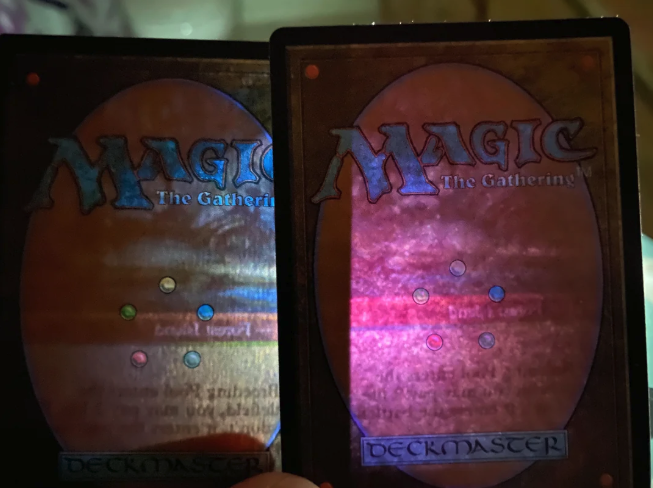
The green dot test is the most widely quoted check for counterfeit Magic cards. You look at the green circle on the back of the card through a loupe, and a genuine card shows four small red dots inside it, arranged in an "L" shape. Many fakes have no red dots at all. It takes a minute and a cheap loupe, but it is not foolproof: some counterfeiters have started to reproduce the dots, worn genuine cards can fail it, and a card with a genuine back can still have a fake front. This guide shows how to do it properly and how to read the result.
Step-by-Step Guide
Get a loupe and a reference card
You need a jeweler's loupe or a strong magnifier, and a card you know is genuine to compare against. Some guides cite 10x as a minimum, and a loupe of 30x or higher is commonly recommended. A clip-on macro lens for a phone can also work, and it lets you photograph the result.
Find the green circle on the back
Turn the card over. The back shows the five-color mana wheel, and the test looks inside the green circle. The back design has stayed the same since the earliest sets, so in principle the test applies to cards of any era, though you should compare against a reference card from the same period.
Look for four red dots in an L shape
Through the loupe, look for small red dots inside the green circle. On a genuine card there are four: three in a vertical line, and a fourth at the bottom of that line, extending to the right, which together form an "L". The dots are subtle, so change the angle and the lighting until they come into focus.
Tip: Check the reference card first so you know exactly what the L looks like at your magnification, then look at the suspect card.
Read the result carefully
If the red dots form the L, that is a good sign, not proof. If the dots are missing, that is a strong red flag, but a worn or damaged genuine card can have a distorted pattern. Some counterfeiters now copy the dots, and a card assembled from parts of different cards can pass on the back while the front is fake.
Cross-check with other tests
Run the T-test on the same side of the card, check the rosette pattern of the printing with a 30x loupe, compare the weight (genuine cards are about 1.7 to 1.8 grams), and look at the front for crisp text and an even black border. For high-value cards, buy graded or from an established seller.
The Green Dot Test at a Glance
What to look at and how to read it.
| What you see | What it suggests | What to do |
|---|---|---|
| Four red dots in an L inside the green circle | A good sign, not proof | Run the T-test, the rosette check and weight |
| No red dots, or no L | A strong red flag | Check a reference card, then treat the card as suspect |
| A pattern that looks distorted on a worn card | Could be a genuine card with wear | Look at the other tests before deciding |
| Dots present but the card feels or weighs wrong | Some fakes copy the dots | Trust the other signals and get a second opinion |
The full set of checks
The green dot test is one of several. See how it fits with the T-test, the rosette pattern, weight and the light test, and when to get a card graded.
How to tell if an MTG card is fake →The other back-of-card check
The T-test looks at the edges of the capital T in "The Gathering" on the same side of the card.
The MTG T-test →Make It Easier with Lotus Scan
Lotus Scan for iPhone simplifies this entire process with AI-powered card recognition, real-time price tracking, and intuitive collection management. Just point your camera and scan.
Frequently Asked Questions
What is the green dot test in MTG?
What magnification do I need for the green dot test?
Can a fake card pass the green dot test?
Can a real card fail the green dot test?
Does the green dot test work on old cards?
Is the green dot test the same as the rosette test?
Pro Tips
- The green dot test is a strong negative signal and a weak positive one. Missing dots should worry you, and present dots should not reassure you on their own.
- Always compare with a genuine card. The dots are small and the comparison removes guesswork.
- Check both sides of a suspect card, since a fake front can sit on a genuine back.
- Do not rely on the light test, rip test or bend test as substitutes. Non-destructive checks on the back give better information.