How to Do the MTG T-Test to Check for Fake Cards
A step-by-step guide to help you do the mtg t-test to check for fake cards quickly and accurately.
Not sure what you have?
Scan a card to confirm its printing and price before you buy or trade. Free on iPhone.

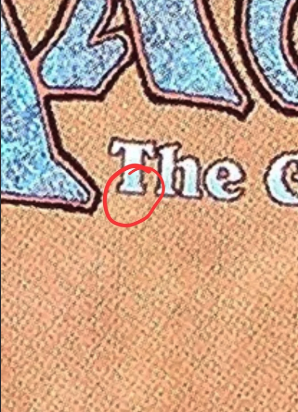
The MTG T-test is one of the quickest checks for a counterfeit Magic card. It looks at a single letter: the capital T in "The Gathering" on the back of the card, just below the Magic logo. Under magnification, the edges of that T on a genuine card look slightly wavy, while many fakes look smooth or blurry. It takes under a minute and needs only a loupe or a phone camera, but it is a community method rather than an official Wizards of the Coast test, and it should never be your only check. This guide shows how to do it and where it can mislead you.
Step-by-Step Guide
Get a reference card and a magnifier
Pick a card you know is genuine, ideally from the same era as the suspect card, and something to magnify with. A jeweler's loupe is the standard tool, and a phone with a good zoom or a clip-on macro lens also works. Without a reference card you are guessing, because the whole test is a comparison.
Tip: Keep one genuine reference card from each era you handle in a sleeve, so you always have something to compare against.
Find the T on the back of the card
Turn the card over. Under the Magic logo is the text "The Gathering", and the test looks at the capital T at the start of "The". Make sure the card is sharply lit from the front and that your magnifier is steady. Resting your elbows on a table helps.
Look at the edges of the T
On a genuine card, guides describe the edges of the T as slightly wavy or sawtooth-like, a side effect of how the back is printed. On many counterfeits the same edges look smooth, soft or blurry. Guides describe the exact pattern a little differently, some pointing to the right edge and some to the bottom, so do not memorize one version. Look instead for a difference between your two cards.
Tip: If you are unsure what you are seeing, check the reference card first, then the suspect card, in the same light and at the same distance.
Photograph both cards side by side
Zoom in with your phone and take one photo with both cards in the frame, with the same lighting and the same zoom. A side-by-side image makes small differences far easier to see than memory does, and it gives you something to show a seller or a community if you want a second opinion.
Combine it with other tests
A card that passes the T-test is not proven real, and a worn genuine card can look odd. Better counterfeits may copy the pattern, and a card assembled from parts of different cards can pass on one side and fail on the other. Run the green dot test and check the rosette pattern as well, compare the weight, and for anything valuable buy graded or from an established seller.
The T-Test at a Glance
What to look at and how to read it.
| What you look at | Genuine card | Suspicious card |
|---|---|---|
| Edges of the capital T | Slightly wavy or sawtooth-like | Smooth, soft or blurry |
| Next to a genuine card | Looks the same as your reference | Visibly different in the same light and zoom |
| Other tests on the same card | Green dot, rosette and weight all agree | One or more of them fail |
A community test, not an official one
The T-test comes from the Magic community rather than from Wizards of the Coast, and guides describe it slightly differently. That does not make it useless, because the comparison with a real card is what matters, but it does mean it should be one of several checks and not the only one.
The full set of checks
The T-test sits alongside the green dot test, the rosette pattern, weight and the light test. See how they fit together and when to get a card graded.
How to tell if an MTG card is fake →The other back-of-card check
The green dot test looks at four small red dots inside the green circle on the back of the card.
The MTG green dot test →Make It Easier with Lotus Scan
Lotus Scan for iPhone simplifies this entire process with AI-powered card recognition, real-time price tracking, and intuitive collection management. Just point your camera and scan.
Frequently Asked Questions
What is the T-test in MTG?
Is the T-test reliable?
Where is the T on an MTG card?
Do I need a loupe for the T-test?
What if the T looks wavy but the card feels wrong?
Should I do the T-test on every card?
Pro Tips
- Treat the T-test as one signal. A pass is not proof, and a fail on a worn card is not proof either.
- Compare against a card from the same era, because printing details can change between sets and years.
- Check both sides of a suspect card. A fake front can sit on a genuine back, and the other way around.
- Do not damage a card to test it. The T-test is non-destructive, which is the point.